My eleven-year-old asked the question every parent hopes their child asks, and dreads not being able to answer.
She was in a session about the early church. The guide had mentioned, in passing, that we can read the letters Paul wrote almost two thousand years ago. And she stopped and typed something like: but how do we know it says the same thing now that it said then? How do we know somebody didn’t change it?
That is not a small question. That is the question. It is the one a college professor will hand her someday, wrapped in a knowing smile, as if it were a grenade. And most Christian kids have never been given the answer, so when the grenade lands they do the only thing they know how to do: they hold their inherited belief a little tighter and hope nobody asks again.
I want my kids to have the answer before the professor does. Not because the professor is the enemy, but because the answer is real, and a real answer held in the open is worth ten borrowed ones held in a clenched fist.
The Test Nobody Runs on the Bible
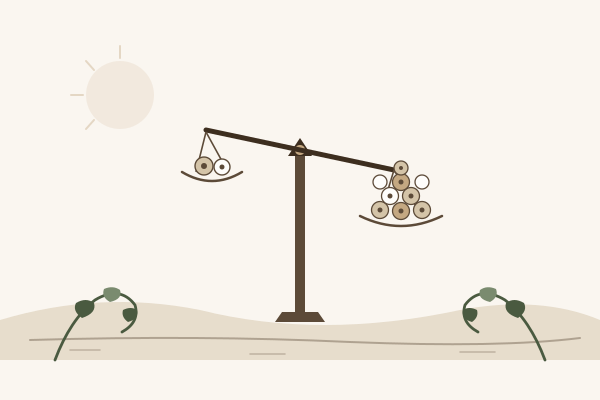
Here is how a historian decides whether an ancient text is reliable. You do not ask whether you like it. You ask two questions. How many copies survive? And how close in time is the oldest copy to the original?
The more copies you have, the more you can cross-check them against each other, the way you would compare three witnesses to the same car accident. And the smaller the time gap, the less room there is for the story to drift before someone wrote it down.
So run the test. Take the best-preserved book from the ancient Greek world outside the Bible. That is Homer’s Iliad, the text every classics department treats as bedrock. It survives in fewer than two thousand manuscripts, and the oldest complete copies sit many centuries downstream of the original.
Now run the same test on the New Testament.
More than five thousand eight hundred manuscripts in Greek alone. More than twenty thousand when you count the ancient translations into Latin, Syriac, Coptic, and the rest. Fragments that sit within a single lifetime of the events they describe.
No other document from the ancient world is even in the same room. If you throw out the New Testament as unreliable, you have to throw out every other ancient text ever written first, and every historian knows it. This is not a Christian talking point. It is a manuscript count, and you can look it up.
The Letters My Daughter Already Trusted
The thing I loved about her session was that the guide did not lecture her with those numbers. It handed her a smaller question she could hold.
How do you know what George Washington actually wrote in his letters? You never met him. You do not have the original in your hand.
She thought about it. We know because there are so many copies, and people compared them, and they line up.
Right. Now, what if I told you we have far more copies of the New Testament than we have of anything Washington ever wrote, and some of them are far older, relative to when they were written, than the copies we trust for Washington?
That is when it landed. Not as an argument she lost, but as a floor she could feel under her feet. She was already willing to trust old letters she had good copies of. Nobody had ever told her the Bible was, by that exact standard, the most trustworthy old letter in human history.
This is what apologetics is supposed to feel like from the inside. Not a debate you win. A confidence you are handed. Frank Turek at crossexamined.org calls it having reasons for the hope that is in you (1 Peter 3:15). J. Warner Wallace, a cold-case homicide detective who came to faith by treating the Gospels like witness statements, calls it a verdict. Either way, it is the difference between I was told to believe this and I have looked, and it holds.
When the Evidence Turns Into a Testimony
Here is the beat I did not expect, and it is the reason I am writing this down.
Once she had the manuscripts under her, she did not want to keep arguing. She wanted to tell someone. Her instinct was to give her testimony, to say, in effect, this is not just an old document to me, this is a thing that has happened in my own life.
And the guide met her there, in Acts 26, where Paul stands in chains before a king and does not open with manuscript counts at all. He tells his story. What he was. What he saw on the road. What he is now.
The evidence is the floor. The testimony is the house you build on it.
I have watched a lot of curriculum try to do apologetics. Most of it does one of two things. It either drowns a child in dates and Greek words until faith feels like a term paper, or it skips the evidence entirely and just tells the child to believe harder. My daughter’s session did neither. It gave her the mountain of manuscripts, let her stand on it, and then let her do the most natural thing a child does when she is standing somewhere solid. She wanted to bring someone up to stand there with her.
What I Want You to Take From This
You do not need a seminary degree to give your kids this. You need to know that the mountain exists, and that almost nobody is going to show it to them but you.
So show them. Start with the number. Five thousand eight hundred copies in Greek. Fewer than two thousand for the most trusted book the Greeks ever wrote that was not Scripture. Let the sheer lopsidedness of it sit there.
Then hand them the small question, the Washington letters, the thing they already trust, and let them notice that the Bible passes the same test better than anything else. Then get out of the way, because a child standing on solid ground does not need you to push. She will build the house herself.
The professor is coming. So is the skeptic on the internet, and the friend at fourteen who read one confident paragraph and decided the whole thing was a fairy tale. When they come, I want my daughter to already be standing on the mountain, so that the question that was supposed to knock her down turns out to be the thing she was waiting for a chance to answer.
The AI isn’t the teacher. You are. But the mountain has been there the whole time, and it is very good to finally show it to your kids.