The best thing a screen can do for a child is send him back outside.
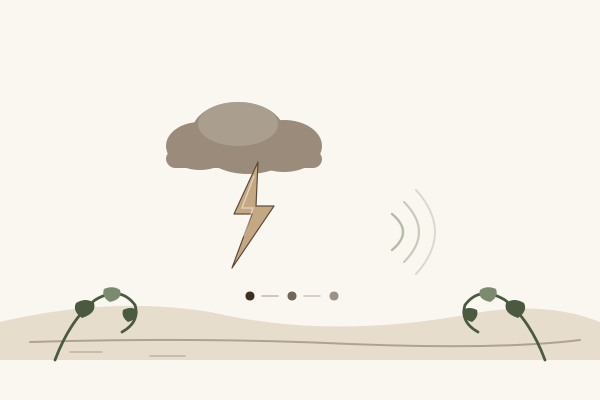
My nine-year-old had been turning a thunderstorm over in his head. He had watched one roll through the day before, and it had left him with questions, the way weather does when you are nine and actually paying attention. Why the thunder came after the lightning. Why some of it was close and some of it was far. Whether you could tell.
So he opened a science session about it. And they talked, back and forth, the way these sessions go, until the guide did the thing I most want it to do. It stopped explaining and gave him a job.
Next time you see lightning, count the seconds between when you SEE the flash and when you HEAR the thunder. Want to try it on the next storm?
That is the whole game right there. That one move is why I built this.
The Sky Is Legible
Here is the science, and it is genuinely beautiful. When lightning strikes, the flash reaches your eyes almost instantly, because light is fast beyond a child’s ability to imagine. But the sound of the thunder is comparatively slow. It travels about one mile every five seconds.
Which means the gap between the flash and the boom is not random. It is information. Count five seconds and the storm is a mile off. Count ten and it is two miles. Count the gap shrinking over twenty minutes and you know, with your own body and no instrument at all, that the storm is walking toward you. Count it stretching and you know it is leaving.
A nine-year-old standing in his own backyard can measure the distance to a thunderstorm using nothing but his eyes, his ears, and his ability to count. The tools were installed at the factory. He just had to be told they were there.
I find that almost unbearably good. Not the trick itself, though the trick is fun. What gets me is the fact underneath it: the world is built to be read. The gap between flash and thunder is a sentence, and a child who knows how to count can read it. That is not an accident of physics we happened to luck into. That is a creation wired, top to bottom, to be knowable by the creatures placed inside it.
Observation Is the Oldest Science
The modern instinct is to think science happens in a lab, in a coat, with equipment. But the oldest and deepest science is just careful looking. Adam’s first assignment in the garden was to observe the animals closely enough to name them (Genesis 2:19). David learned the sky well enough to write the heavens declare the glory of God (Psalm 19:1), and he learned it the only way anyone ever has, by lying in a field at night and paying attention. The book of Job is full of God asking, in effect, have you actually looked? Do you know how the light is distributed, where the rain is born, how the storm is bound? (Job 38). The rebuke is not “you failed the exam.” It is “you never really looked.”
This is what I want the screen to do for my kids. Not replace the field. Point them back to it. A child who learns the flash-and-thunder trick cannot un-know it. For the rest of his life, every storm becomes a thing he can read. He will stand at a window at forty and catch himself counting, and some small part of him will still feel the wonder of it, that the sky was talking the whole time and somebody once taught him the language.
Why the Job Matters More Than the Answer
The guide could have just told him. The storm was two miles away, here is the formula, moving on. It would have been correct and it would have been forgettable. Instead it handed him a job he had to take outside and finish with his own body, on his own next storm, in his own backyard.
That is the difference between information and formation. Information is something you are given. Formation is something you do until it becomes part of how you see. My son does not now know a fact about thunder. He has a new sense. The next storm is going to find him counting, and the storm after that, and the counting is going to teach him things about patience and distance and the shape of weather that no paragraph ever could.
Screen time that ends on the screen is a dead end. Screen time that ends with a child looking up at the actual sky, doing something with his actual hands, is the only kind worth defending.
We have a rule, running underneath everything the guide does, that hands-on beats screen-on every time we can arrange it. The activities are supposed to use what is already in the house and the yard, a jar, a walk, a window, a count. Not because we are anti-technology, but because the technology is at its best precisely when it makes itself unnecessary, when it hands the child back to the world and steps out of the way.
The storm will come back. When it does, I know exactly where my son is going to be. Not at the iPad. At the window, then the porch, watching for the flash, and counting, one, two, three, reading a sky that was legible all along.
The AI isn’t the teacher. The sky is one of them. And the best thing the screen ever does is remember that, and send your child back out to it.