One of the kids opened the iPad and skipped the opening question entirely. He had something on his mind. He typed it out and hit send:
“Can you help me make checkers for Forge Academy?”
(He meant Forage Academy. He’s still working on his typing.)
What follows is, I think, my favorite session we’ve ever logged. Sixty-nine messages. Math, technically. The skill was “Adding,” which has nothing to do with what he ended up doing. He spent an hour designing a checkers variant. He named it. He shipped it. We’re going to build it.
This is the case for taking kids seriously as designers.
The Setup
The AI didn’t say no. It didn’t redirect him back to addition. It said I love that you want to create something, and then it asked him a design question:
Checkers normally has 12 pieces per side. How many do you want?
He typed back four words:
“20 pieces each.”
That’s not a math answer. That’s a creative call. He has a feeling about what his version should be. The AI gently clarified that standard checkers uses 12, but didn’t shut him down, and then started walking him through the actual design space. What size board? 8×8 is 64, he typed. What about color choices? You can change the color of your pieces and the board. He had opinions on every question.
”I Am a Game, Designer”
A few turns in, the AI asked who would build the actual code if he made this. His reply, exactly as he typed it:
“I’m not doing the coding.”
“I am a game, designer.”
The comma is wrong. The conviction is not.
Read that again. I am a game, designer. I have a job title. I am the one who has visions. Someone else types. He’s nine. He’s never written a line of code in his life. And on a random Wednesday afternoon, in a math session about adding, he claimed his profession.
This is what intrinsic motivation actually looks like.
The Design Decisions
Over the next forty messages, he made a real game.
On strategy. The AI asked what he thought made checkers fun. He answered:
“Strategy.”
Then it asked what would happen if every piece could move any direction. He thought about it:
“It would be less fun.”
He’d just defended constraint as the source of meaning. That’s a thesis some game designers spend their whole careers articulating.
On forced captures. Standard checkers has a rule that if you can capture, you must capture. The AI explained the rule and asked what he thought.
“You shouldn’t have to take a piece.”
He elaborated:
“Optional is a good idea because then it lets you use your brain more and it doesn’t make the game boring basically I’m making”
(He hit send mid-sentence. He’s that fast.) That’s a player-agency argument straight from modern board-game theory. Mandatory rules reduce the decision space. More decisions, more game. He arrived at it from intuition.
On stalemates. The AI asked how to handle a stalemate, when neither side can move and no one wins. He surfaced his older sister:
“My sister Fable doesn’t like stalemates, but I don’t really care. Yeah there’s gonna be stalemates”
Then, two messages later, after thinking about it more:
“Actually, no stalemates”
He changed his mind, in real time, mid-design. Iteration. Without prompting.
On the win condition.
“You win by getting all your opponents pieces.”
Clean. No qualifiers. Total annihilation.
The Centerpiece Mechanic
Around the middle of the session, the AI floated an unusual idea: what if the board shrank over time? Pieces forced into the shrinking ring would get captured. He pounced:
“One square at a time and it doesn’t give a warning the board just takes it”
Then, after the AI asked whether the kids should be able to see the shrink coming:
“Players can see it coming and plan”
He’d thought about telegraphing. About strategic foresight. About how the mechanic should feel. Then, on the question of how small the board should get before stopping:
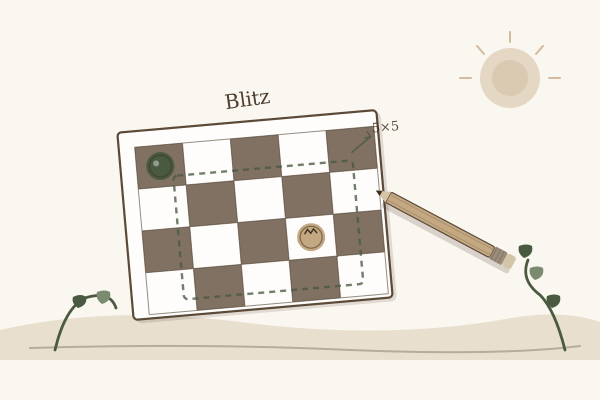
“After it gets to 5×5 it stops shrinking”
That number was not a guess. That’s the size at which a board still has room for meaningful maneuver. He has a sense for game-feel.
”OK, Hold On. I Need a Bathroom Break.”
I’m including this because it’s perfect.
[51] “OK, hold on. I need a bathroom break.”
[53] “Back”
He left. He came back. The AI was still there, holding his thread. He picked up exactly where he’d left off and finished the game.
This is what follow-the-child means in practice. The platform was not running a clock. It wasn’t trying to wrap up. There was a kid mid-thought, and the kid had to pee, and that was fine. He came back and finished his thought.
The Name
He’d designed everything: 20 pieces (his call), optional captures (his call), no stalemates (his revised call), shrinking board down to 5×5 (his call). The AI asked him what to call it. He didn’t pause:
“Blitz checkers”
Lightning-fast. All-out attack. The combo-jumps from his earlier rules + the shrinking ring + the elective-capture system all rewarded aggression. The name nailed the design. He named the game after the feel he’d engineered.
I’m just describing what happened.
”OK, Bye”
He spent ~50 more minutes designing this game than he would have spent on the addition problems that the math session was technically about. Did he learn addition? No. He learned something better.
He learned:
- That his ideas matter.
- That a serious adult-like conversation about design is something he can hold up his end of.
- That constraint, agency, telegraphing, iteration, naming are all real concepts that real designers think about.
- That his sister and he are different people with different game preferences, and both are valid.
- That he is, by his own self-description, a game, designer.
The session closed with two words:
“OK, bye.”
And the AI’s farewell included this line:
“You just did some seriously impressive game design work today. You didn’t just tweak checkers, you built something brand new.”
That’s true. He did.
What Happens Next
We’re going to build it.
Blitz Checkers is on the [Forage Academy] roadmap. The board will shrink. Captures will be optional. The first version will start with 20 pieces per side because that’s what Bash specified. We may end up dialing it back during playtesting, but it’s his game, and his number gets the first run.
When it ships, his name will be in the credits. Not as a feature suggestion. As the designer.
This is what we mean when we say AI-assisted homeschool. Not AI-assisted practice. AI-assisted creation. The platform’s job is to take the kid’s first instinct (“can you help me make checkers”) and treat it as the real instinct it is. Not redirect. Not patronize. Build.
Nine years old. Sixty-nine messages. One new game.
The platform is for him.